
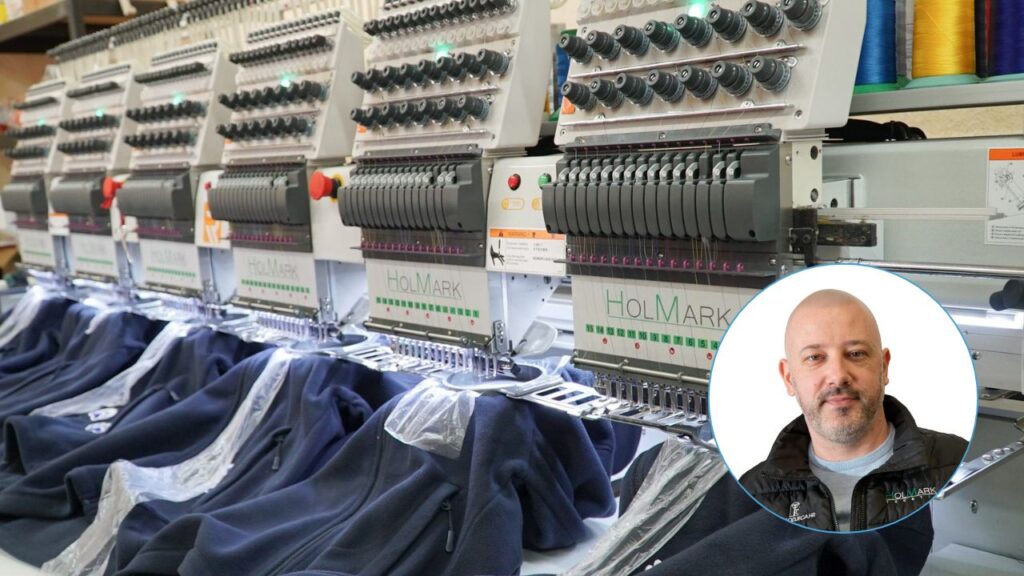
Machine embroidery ensures the greatest durability of personalized designs on fabric. Often, the embroidery on a product outlives the product itself. To find out just how demanding this technology is, we visited the production facility of the Holmark craft, owned by Mr. Marko Holjak.
What is your core business today, and what are your capacities?
More than 60% of our turnover comes precisely from the field of machine embroidery, although in recent years we also decorate a portion of our products with DTF printing. The reason for this is lower cost and speed, and the products that get DTF are usually cheaper with a shorter lifespan, such as T-shirts.
Although we are not the largest in terms of the number of heads installed in the facility, we have modern machines and are one of the most productive facilities in Croatia. We have two six-head machines and one two-head machine. All three machines are so-called heavy-duty models designed to run three shifts, seven days a week.
You are tied to Ricoma technology. How do you rate it compared to other brands?
Yes, we work exclusively on Ricoma machines. The machines we have in our facility are designed for industrial production and are highly durable. In my opinion, with the right knowledge and proper adjustment, Ricoma can deliver the same or even better results than some competing machines that are significantly more expensive. Our machines are not “plug and play” and are not meant for beginners. Durability and speed are important to us, and that is what we get with this technology. With the help of an experienced operator, this technology enables premium quality with a more favorable cost-to-benefit ratio.
Of course, high-quality technical support is also extremely important. Today, we handle most of the machine interventions on our own, but we always have the company Sivanol backing us up, whom we rely on in the event of any major problem.
What role do software and knowledge play in the machine embroidery process?
We are currently working in Stilista (GMI), but we are considering switching back to Wilcom. Today’s software has advanced significantly and simplified the digitizing/setup process itself, but a high level of knowledge is still required to create premium embroidery. Serious embroidery requires manual digitizing. The prep worker must know the material being worked on, as well as the different types of stitches that will best highlight the logo on the backing, and, of course, use the appropriate thread.
Working on an embroidery machine requires experience. Embroidery has never been a quick and easy-profit technology. It is a business of knowledge, experience, and precision. However, when set on a healthy foundation, with the right technology, quality materials, and educated people, it can become an exceptionally stable and long-term business.