




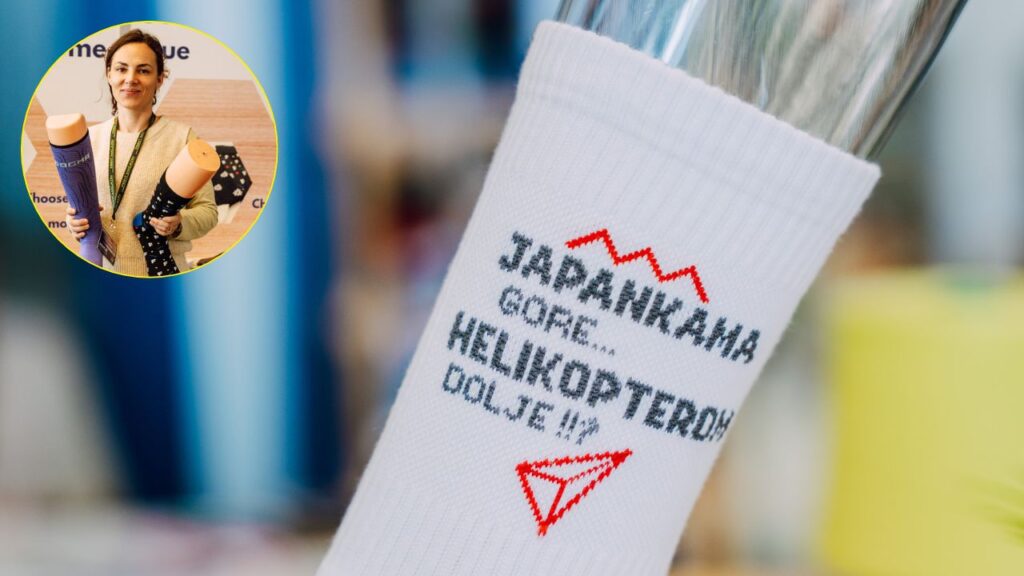
Customers today seem unwilling to accept “ordinary” products in any segment, they expect something unique and recognizable. Socks, once a basic garment, have become a means of expressing identity and differentiation. Personalization has played a key role in this transformation. From the first cotton socks with a single logo to today’s advanced designs that combine technology, comfort, and brand identity, the industry has evolved alongside market demands. How this transformation unfolded and what it means today for sports and fashion is explained by Ms. Morena Makar, Head of Sales and Marketing at the family-owned company Makar from Samobor, which has been producing socks for over 30 years.
How did personalization become part of your offering?
When the company started 34 years ago, only classic cotton socks were available, and machines had far fewer technological capabilities. It was possible to add one small, simple logo and not many colors. However, as in all industries, technology evolved, new materials emerged, and customers became increasingly demanding. They wanted something “different,” and requests for personalization began to grow. The logical step was to address this and include it in our offering. Today, this category represents a very large share of our business.
Have you encountered any unusual requests?
Unusual requests were more common in the fashion sock segment. One well-known domestic company producing alcoholic beverages wanted socks with a hole in the sole for a campaign, so we had to improvise to avoid literally producing socks with holes. By combining materials and techniques, we achieved the visual effect of a hole.
How important is technology in the personalization process? Do you use specific software or machines to enable a high level of customization?
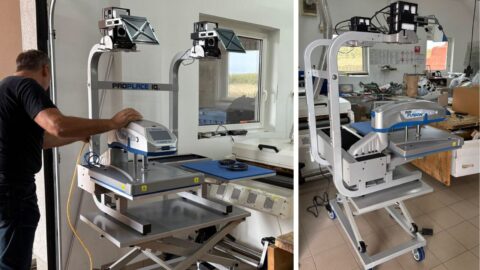
Today, it is possible to combine different complementary technologies to achieve the desired or unique effect. In addition to knitting technology, where the pattern is integrated in a single process, more demanding or innovative designs can use digital printing, heat-applied labels, embroidery technology, textile labels, non-slip silicone elements, and more. The possibilities are truly extensive—only creativity is needed to create a unique product. Of course, these additional elements slow down the process and increase the product cost.
Do you offer personalization in small batches or only for larger orders?
Our personalization is based on a minimum order of 100 pairs, or 50 pairs per size range. Size ranges are defined according to client needs and are most often triple sizes, for example 36–38. Due to the complexity of the personalization process, creating special programs, adjusting machines for each size, and changing materials, we cannot produce smaller quantities than that.
What sets Makar apart from the competition when it comes to personalization of sports socks and other accessories?
In addition to being regularly involved in sports, allowing us to immediately recognize needs, shortcomings, and advantages of specific products, we also have a wide circle of clients from various sports, clubs, and organizations, from whom we receive valuable feedback on existing products as well as ideas for new ones. There is also our Dogma brand, present on the market for about ten years, through which we continuously introduce new technologies and develop new products. Furthermore, we consistently invest in new machines and in our employees. All of this helps us develop trends and deliver innovations to our clients.