
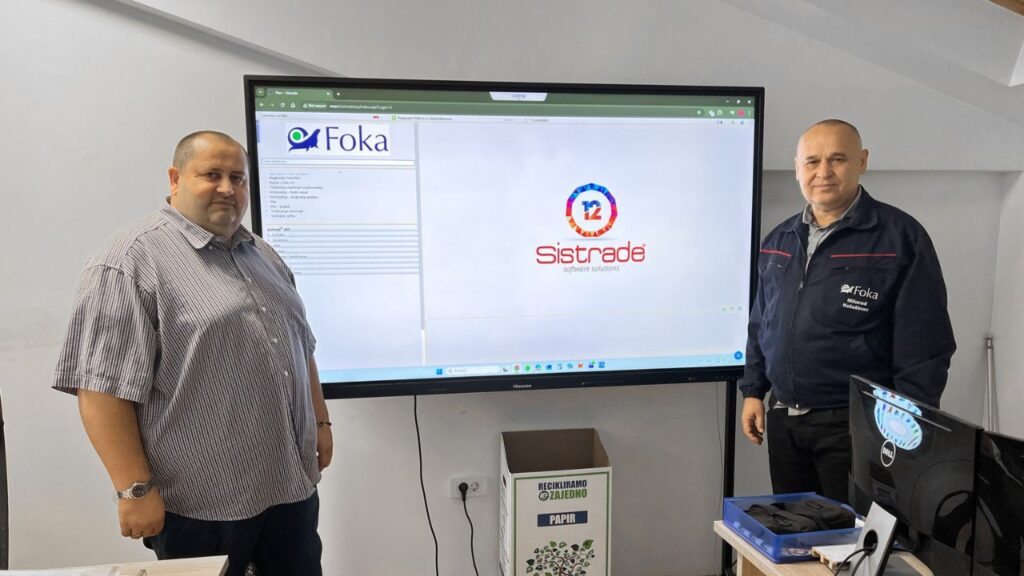
The growth in workload and increasing production complexity were putting more and more pressure on existing tools, leading the Serbian company Foka to realize that stable growth was no longer possible without a robust software solution tailored to the flexible packaging industry. Customers demand fast response times, precise calculations, reliable traceability, and quality control at every stage. Sistrade MIS/ERP has successfully met these requirements. We spoke with Mr. Milorad Kolašinac, Production Director at Foka, about the reasons behind the implementation, the challenges, the results, and future plans.
As he explained, Foka d.o.o. has been operating since 2000 and is privately owned. Over the years, it has developed into a well-established regional manufacturer of multilayer flexible packaging materials, primarily for the food industry. Today, the company employs around 200 people and continuously invests in technology and product quality. A particular focus is placed on the development of high-barrier packaging, as well as customized solutions tailored to client needs.
What was the key moment when you realized that you could no longer operate without serious, industry-specific software?
Foka has an extremely wide product portfolio. As the volume of work and the complexity of orders increased, it became clear that we could no longer efficiently track information using Excel spreadsheets and our existing software, which had limited upgrade capabilities and was no longer sufficient for our needs. We needed a serious, integrated system that would enable reliable monitoring of the entire process – from pricing and job creation, through production execution and cost tracking, to quality control.
ERP (Enterprise Resource Planning) and MIS (Management Information System) became essential to ensure faster information flow, more accurate reporting, and a stable foundation for decision-making. In addition, the level of traceability was not satisfactory, which was one of the key motivations for implementing a modern integrated system.
Why did you choose Sistrade? What did the decision-making process look like and which modules did you select?
We chose Sistrade because it is a solution specialized for the packaging industry, with extensive experience in the graphic sector and flexible customization options.
The decision-making process lasted several months and included detailed presentations, test scenarios, and visits to reference users. The final decision was made because Sistrade best met our requirements.
We implemented modules for Sales, Procurement, Logistics, Production Planning, Quality Control, CRM, as well as modules for machine and equipment maintenance, along with other functionalities necessary for our operations.
What were the biggest challenges during the preparation phase and how did the team respond to the new solution?
The preparation and integration phase lasted two years, while parallel operation with the old system lasted about three months. The biggest challenge was changing employee habits. It took time for all departments to align and learn to trust the data provided by the system. We are a relatively young team, which I believe made the process easier.
Through extensive internal training and support from the Sistrade team, we gradually mastered all phases. The most sensitive areas were Sales, Logistics, Production, and Quality Control, but these are also the areas that have seen the greatest improvements today.
In your opinion, why do print companies still resist implementing MIS/ERP solutions? What is the key to successful software adoption in a packaging company?
Many companies still hesitate because they fear that digitalization will slow down processes or require significant investment. Other reasons include lack of time to change established habits, fear of complex systems, and the belief that their current way of working is “good enough.”
However, the reality is that without modern software, it is impossible to remain competitive in the long term, especially in an industry where speed, cost tracking, and traceability are crucial.
The most important step is to thoroughly analyze your own processes and clearly define expectations from the system. It is highly recommended to choose a solution specialized for the industry, as implementation will be faster and results visible sooner. It is also essential to ensure employee commitment and allocate sufficient time for training, as the success of an ERP/MIS project largely depends on team acceptance.
ERP should not be viewed as a cost, but as a foundation for sustainable growth and competitiveness.