Never before has so much been expected of packaging as today. The design must attract the customer and clearly convey the message, while the materials must protect the product and enable recycling. On top of that, the entire solution needs to be practical, cost-effective, and aligned with increasingly complex regulations. At the same time, printing technologies are constantly advancing, unlocking new opportunities for higher quality, more diverse, and more flexible production.
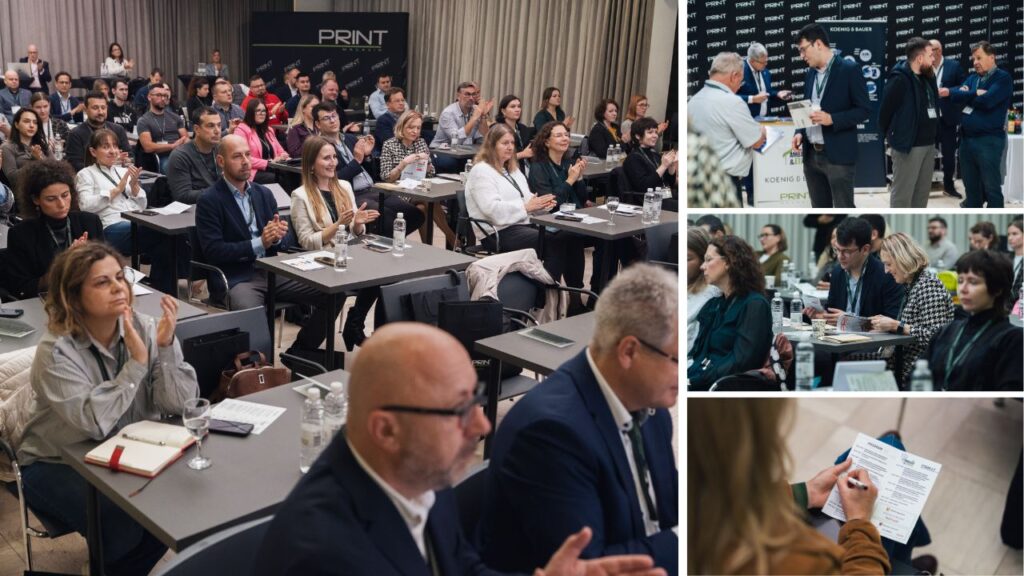
It was precisely between these growing demands and new possibilities that the topics of the 3rd Packaging & Labeling Conference revolved, held on October 22, in the Winter Garden at Zagreb Fair. The conference, organized by Print Magazin, gathered around a hundred participants, mostly representatives of printing houses and packaging end-users.
AI, PPWR, and design were common threads throughout the entire program, from packaging materials and structural design to printing, automation, and production decision-making. Discussions centered on meeting new regulatory requirements while leveraging technology for faster adaptation, shorter runs, and greater customer value. An increasing number of variations and market adjustments demand flexible production, which is expertly addressed by digital printing, enabling print-on-demand, personalization, a broader selection of visual effects, and consequently, wider application possibilities. Meanwhile, automation helps streamline production steps and maintain consistent quality.
The industry is adapting to new regulations, exploring the potential of artificial intelligence, and seeking ways to remain efficient and competitive amidst increasingly demanding orders.
Industry Professionals Under One Roof
An overview of the state of the industry was presented by Sven Heric from the Croatian Chamber of Economy (HGK). Branko Mihorko and Helder Martins from SisTrade spoke about AI agents in manufacturing, while Michael König from Koenig & Bauer focused on autonomous printing. Teodora Gvoka from the Faculty of Technical Sciences in Novi Sad discussed the opportunities and limitations of applying artificial intelligence to packaging design.
Sara Prenc Opacic from Studio Tumpic/Prenc demonstrated how design connects the product, brand storytelling, and customer experience. Miho Karolyi and Zeljka Tihomirovic from Kaligraf brought to light the requirements of design for recycling and the practical implementation of PPWR, while Gregor Lavric from the Pulp and Paper Institute in Ljubljana explained recyclability testing for paper packaging.
Niko Vlastelica from Canon, Juan Cano from Screen Europe, and Admir Joldic from Xerox showcased the capabilities of digital packaging and label printing, along with opportunities to expand offerings that deliver value to customers far beyond just the print itself.
The positive atmosphere was further enhanced by small giveaway games. An engaged audience, thoughtful questions, and active exchanges of experience confirmed that the conference arrived at the perfect time—as the industry simultaneously seeks answers to regulatory changes, new technological capabilities, and evolving market expectations. Once again, the event demonstrated how invaluable it is to bring together those who design, produce, and use packaging under one roof.
Take a look at the photo gallery to see how it went and who attended!
.