
In a market with just over half a million residents, such as Montenegro, speed, flexibility, and reliability are often more crucial than pure production capacity. This is precisely the philosophy driving Golbi Print from Podgorica, one of the most technologically advanced print shops in the region and the only Fogra-certified print shop in Montenegro.
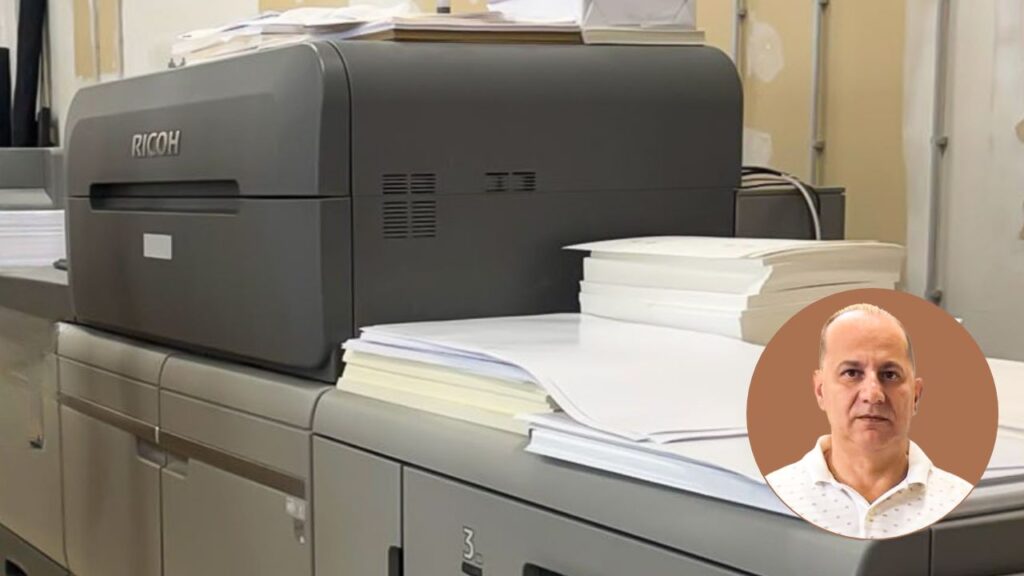
A recent investment in two Ricoh Pro C9500 production systems, delivered and installed by Eurocop, prompted our visit and an interview with the owner, Mr. Boris Gosovic.
Golbi Print is among the most technologically advanced printing businesses in the region today. What did the company’s growth journey look like?
Golbi Print’s beginnings were rooted in traditional offset technology. I started the private business with a small Heidelberg GTO offset press, and as the market shifted toward digital printing, we followed suit.
My initial experience with a smaller digital printer didn’t meet my expectations, but it pushed us toward a more serious investment. After our first Ricoh 7000 series system, we added a second identical unit, and today we operate two Ricoh Pro C9500 systems.
If you want to provide clients with reliability, speed, and quality, you need backup capacity. That’s why we opted for two identical machines. In the Montenegrin market, run lengths are smaller and deadlines tighter, making flexibility and redundancy essential. That is precisely why digital printing is becoming an increasingly vital part of our operations.
What guides your decisions when investing in new technology?
When investing in production equipment, machine quality and post-purchase support are equally crucial to us. That is one reason we chose Eurocop. They have dedicated service technicians in Montenegro, and we are pleased with their response time. If a spare part isn’t available in Podgorica, we get it by the next day.
They approach our partnership very responsibly, completing an entire chain of accountability—just as we are accountable to our clients, they are to us. That forms the core foundation of our business philosophy.
How do you see the graphic arts industry evolving over the next five years?
I see the greatest potential in digital printing. Speed, variability, immediate response capability, and simplified production management are primary market demands today. Moreover, digital technologies attract younger generations of employees because operating digital systems is more dynamic, interesting, and aligned with their mindset.
As for offset, I see huge potential in inkjet technology as a substitute. Today, toner technology is cost-competitive up to a few hundred copies, whereas inkjet can compete up to several thousand. I closely monitor inkjet advancements, though I believe it will take another five to ten years to see its full potential.