
Graficar Ltd. from Bihac (Bosnia and Herzegovina) is a great example of how a traditional printing company can successfully evolve and adapt to changes in the graphic arts industry. As a family-owned business with more than four decades of market presence, the company has focused from the very beginning on investing in knowledge, people and technology. Mr. Mehmed Felic, representing the second generation in the company, continued the development path initiated in the early 1980s by his father.
How did Graficar develop from a family business into today’s leader in this part of Bosnia and Herzegovina?
Our development journey led us from a traditional offset printing company to a modern hybrid production system that today combines offset and digital technologies in line with real market demands. Key milestones included the construction of a modern production facility tailored to contemporary technological requirements, continuous technological upgrades and the strategic digital transformation of our business processes. A particularly important step forward was our decision to clearly position the company through the Print 5.0 concept, which combines technological progress, sustainability and the central role of people in production.
How important has continuous investment in technology been for long-term stability? What are the biggest differences between your production today and 20 years ago?
Investing in technology has proven crucial for the company’s long-term stability and sustainable growth. That is why we have never viewed technology investments as a cost, but rather as a strategic investment in the future.
Compared to production ten or twenty years ago, our core product portfolio has not changed radically, but the key difference today lies in flexibility. We are now able to profitably produce everything from a single copy to medium and large print runs, with significantly shorter delivery times. Our core products include books, monographs, promotional and marketing materials, premium packaging and personalized products, while our technology enables us to produce them quickly, with high quality and fully adapted to client requirements.
I would also like to emphasize that at Graficar we do not view machines individually, but as part of a unified hybrid production ecosystem in which each technology has a clearly defined role. It is precisely this combination of different solutions that enables us to plan future investments long-term and continuously improve both quality and production efficiency.
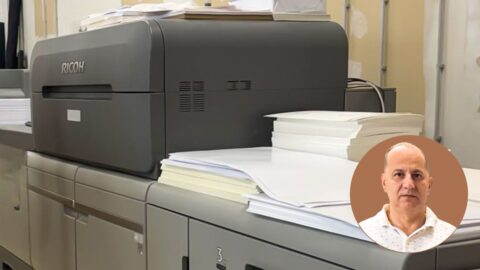
You recently invested in the Ricoh Pro C9500 production digital press and accompanying finishing solutions. What was decisive in making this investment and what benefits does it bring?
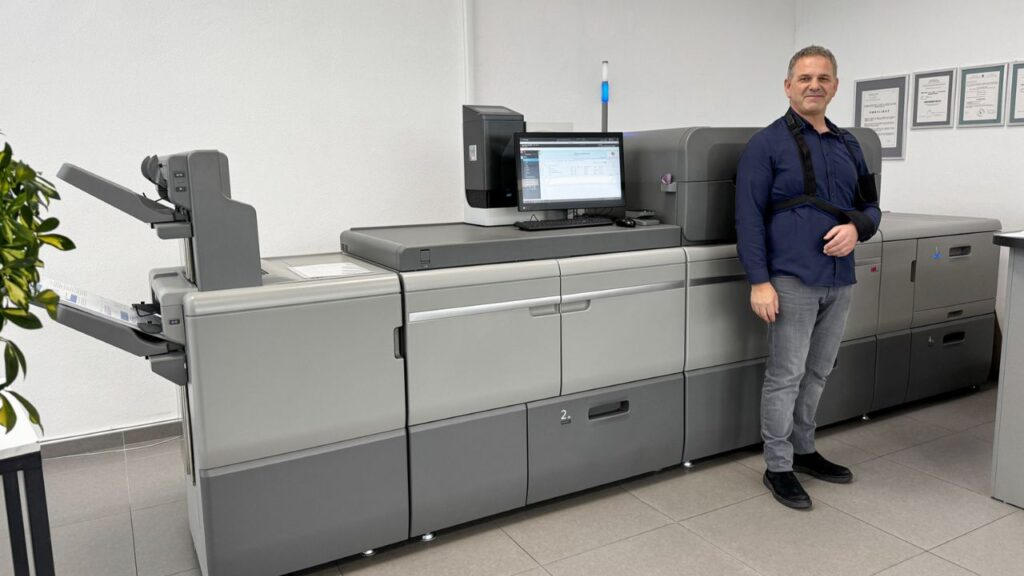
The new investment in the Ricoh Pro C9500 production digital press is a logical continuation of our clearly defined Print 5.0 strategy and an upgrade to our existing digital fleet, which already includes the Xerox Versant 180 and Xerox Versant 4100. We deliberately opted for diversification of our machine park, both from a technological perspective and in terms of long-term production stability and service support. This approach ensures greater flexibility, operational reliability and a better response to diverse market demands.
When choosing the Ricoh Pro C9500, the decisive factors were operational stability, outstanding print quality, flexibility in handling a wide range of media, and strong software and workflow support. This system fits perfectly into our concept of industrial digital production, where repeatability, reliability, energy efficiency and minimal waste are key factors.
We further strengthened our production facility with a modern finishing solution – the Duplo PFI Blade CNC cutter. In combination with a new UV printer, this setup enables us to produce short runs of presentation folders, cardboard boxes, book covers and similar products. We can now enhance them in a very short time with white ink, 3D spot varnish or Braille, and then cut them into complex shapes without the need for die-making.
With this investment, we have completed the entire production process within our own facility, shortened delivery times and significantly increased the added value of our products.